
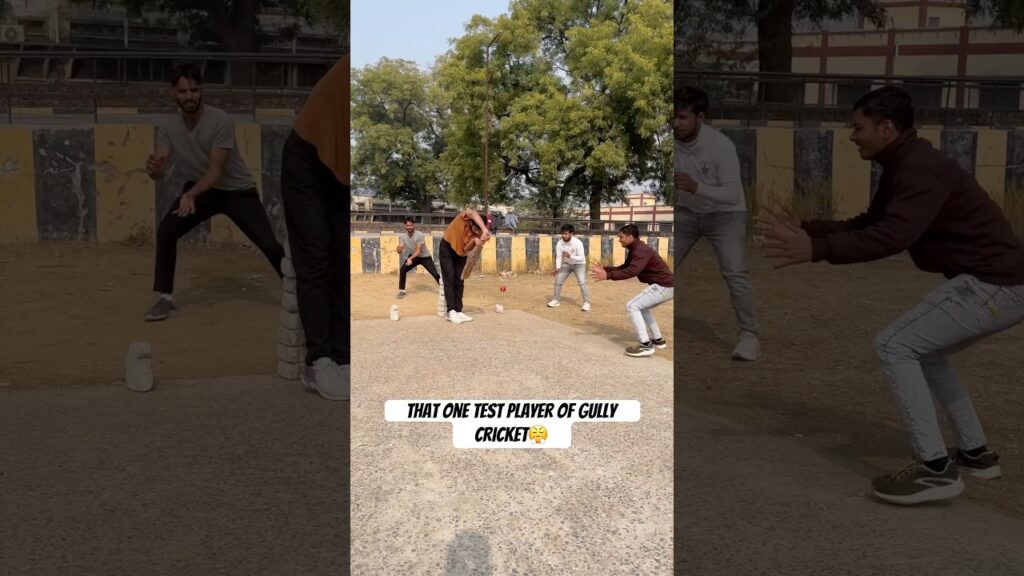
The “Test Player” in Every Gully Cricket Team: A Relatable Struggle
In India, Cricket isn’t just a sport; it’s a religion practiced in the narrow lanes, terrace tops, and dead-end streets of every neighborhood. While Gully Cricket has its own set of unique rules—like “one-tip out” or “the house owner keeps the ball if it lands on their balcony”—there is one constant that remains the same across the country. Every single team has that one legendary Test Player.
You know the one. Even if the match is only 6 overs per side and the sun is setting fast, this player walks out to the crease with the temperament of Rahul Dravid and the strike rate of a snail. Inspired by the viral #shorts trends, let’s dive into why every gully team has this iconic character.
The “Wall” of the Gully
The Gully Test Player doesn’t care about the required run rate. While the rest of the team screams, “Arre, maar na!” (Hey, hit it!), he is busy perfecting his forward defensive stroke. To him, every ball from the neighbor’s 12-year-old kid is an incoming delivery from Mitchell Starc at the Gabba.
This player believes in “settling down” on the pitch. The irony? By the time he is settled, the innings is usually over. He treats a rubber ball or a taped tennis ball with the respect usually reserved for a brand-new red Cherry. For him, a maiden over in gully cricket isn’t a disaster; it’s a masterclass in patience.
Why Does Every Team Have One?
There are usually three reasons why this player exists in your Sunday morning match:
- The Purest: He grew up watching 90s cricket and believes that losing your wicket is a sin worse than breaking a window pane.
- The “Technique” Guy: He might not have power, but he has “elbow.” He will play a beautiful cover drive that travels exactly two meters, while the team yells for him to just slog it over the wall.
- The Anchor (Self-Proclaimed): He thinks he is holding the innings together, oblivious to the fact that he has scored 2 runs off 18 balls in a T-10 format.
The Frustration and the Fun
The beauty of Indian Gully Cricket lies in these characters. The “Test Player” is usually the person who gets the most “advice” from the boundary. From “Next ball pe out ho ja” (Get out on the next ball) to “Batting chhod, bowling kar” (Leave batting, just bowl), the banter is what makes the game memorable.
However, everyone wants him on the team when the pitch is “slippery” or when the bowling side is exceptionally fast. Suddenly, his ability to block everything becomes a tactical advantage, proving that even in the chaotic world of street cricket, there is a place for the traditionalist.
Conclusion
Whether you find them annoying or admirable, the “Test Player” is an essential part of India’s cricket culture. They remind us of the sport’s roots—where surviving an over was just as important as hitting a six. So, the next time your friend plays three consecutive dots in a gully match, don’t get angry. Just remember, they are probably imagining themselves at Lord’s, saving a match for the country!
Frequently Asked Questions (FAQs)
1. What is Gully Cricket?
Gully Cricket is an informal version of cricket played in the streets (gullies) of India and South Asia. It features modified rules to suit small spaces and limited players.
2. Why is the “Test Player” meme so popular on YouTube Shorts and Instagram?
It is highly relatable. Almost every Indian who has played street cricket has encountered a teammate who plays too slowly, making it a perfect topic for relatable comedy sketches and reels.
3. What are some common Gully Cricket rules?
Common rules include “One-tip out,” “No running on a six,” “Electric wickets” (hitting the wall behind the stumps), and “Last man batting.”
4. Is playing like a “Test Player” bad in Gully Cricket?
Not necessarily! While it can be frustrating in short matches, having someone who can defend their wicket helps in avoiding a total collapse when the bowling is tough.
5. Who are some famous Indian “Test” inspirations?
Gully players often mimic legends like Rahul Dravid (The Wall), Cheteshwar Pujara, or Sunil Gavaskar when they decide to play defensively.